Google AI Ecosystem
A current map of Google’s AI ecosystem as of March 16, 2026: consumer products, developer entry points, Google Cloud and enterprise tooling, open models, media generation, frontier research, and the trust layers that connect them.
The ecosystem has two public faces
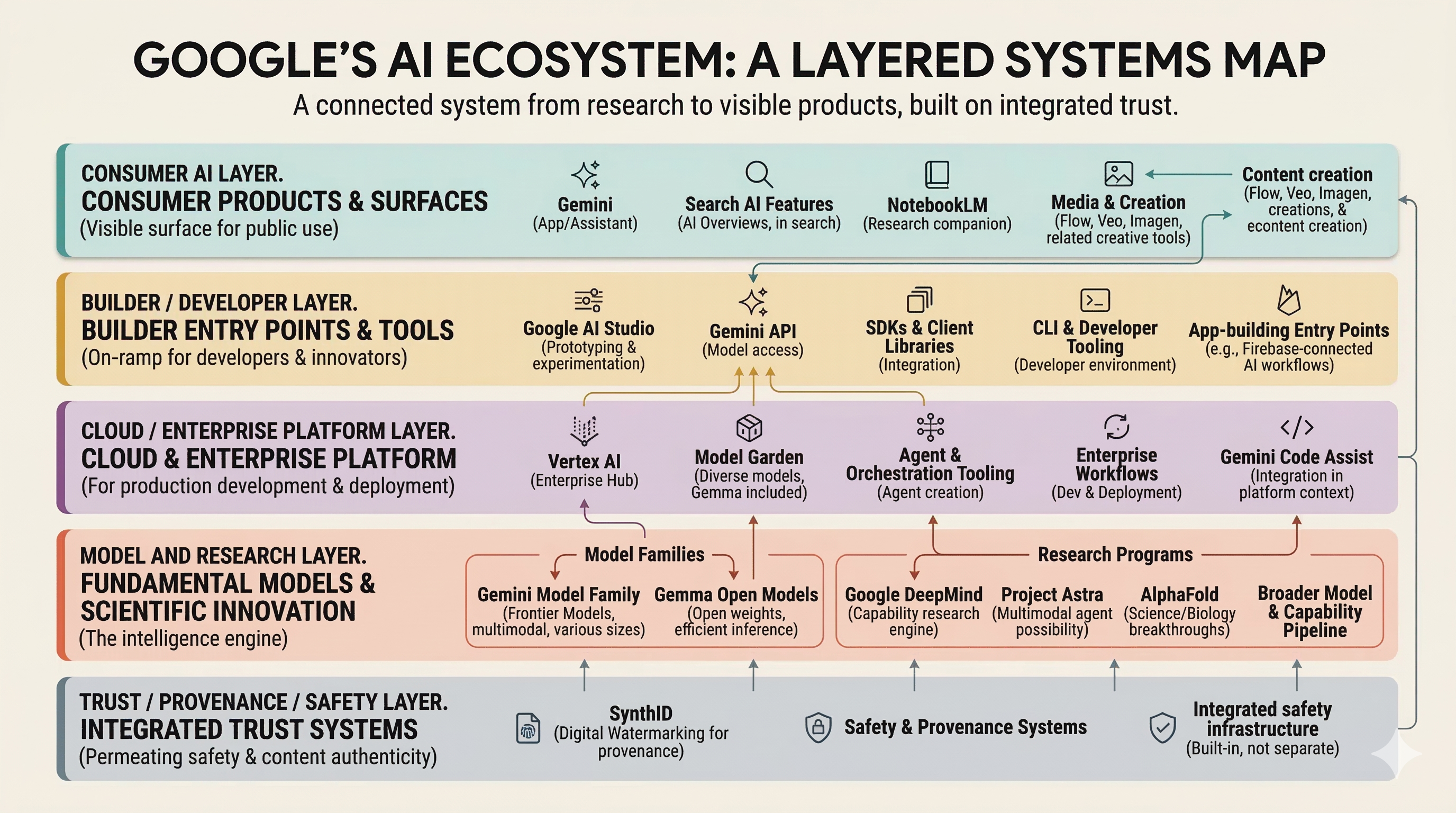
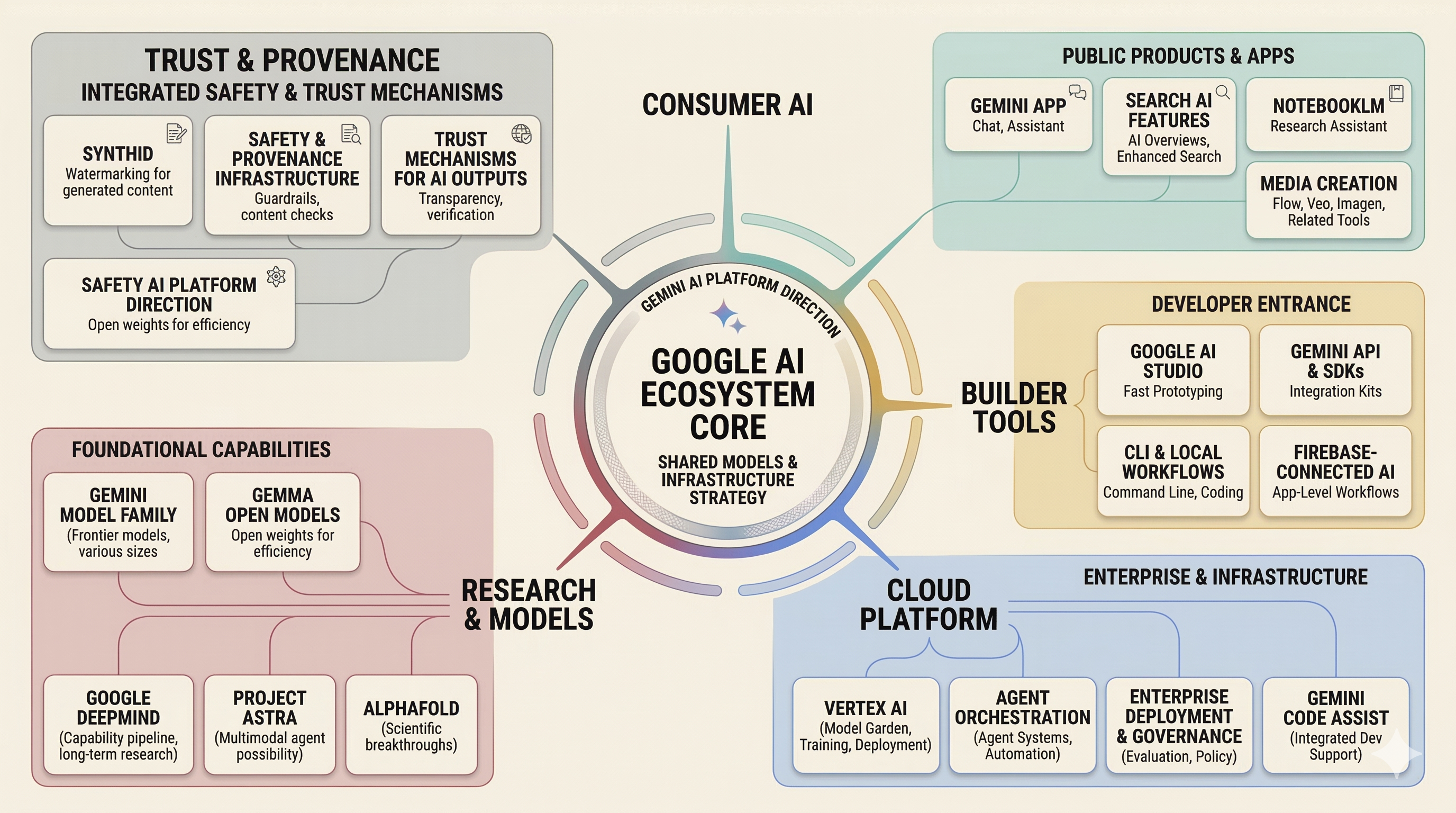
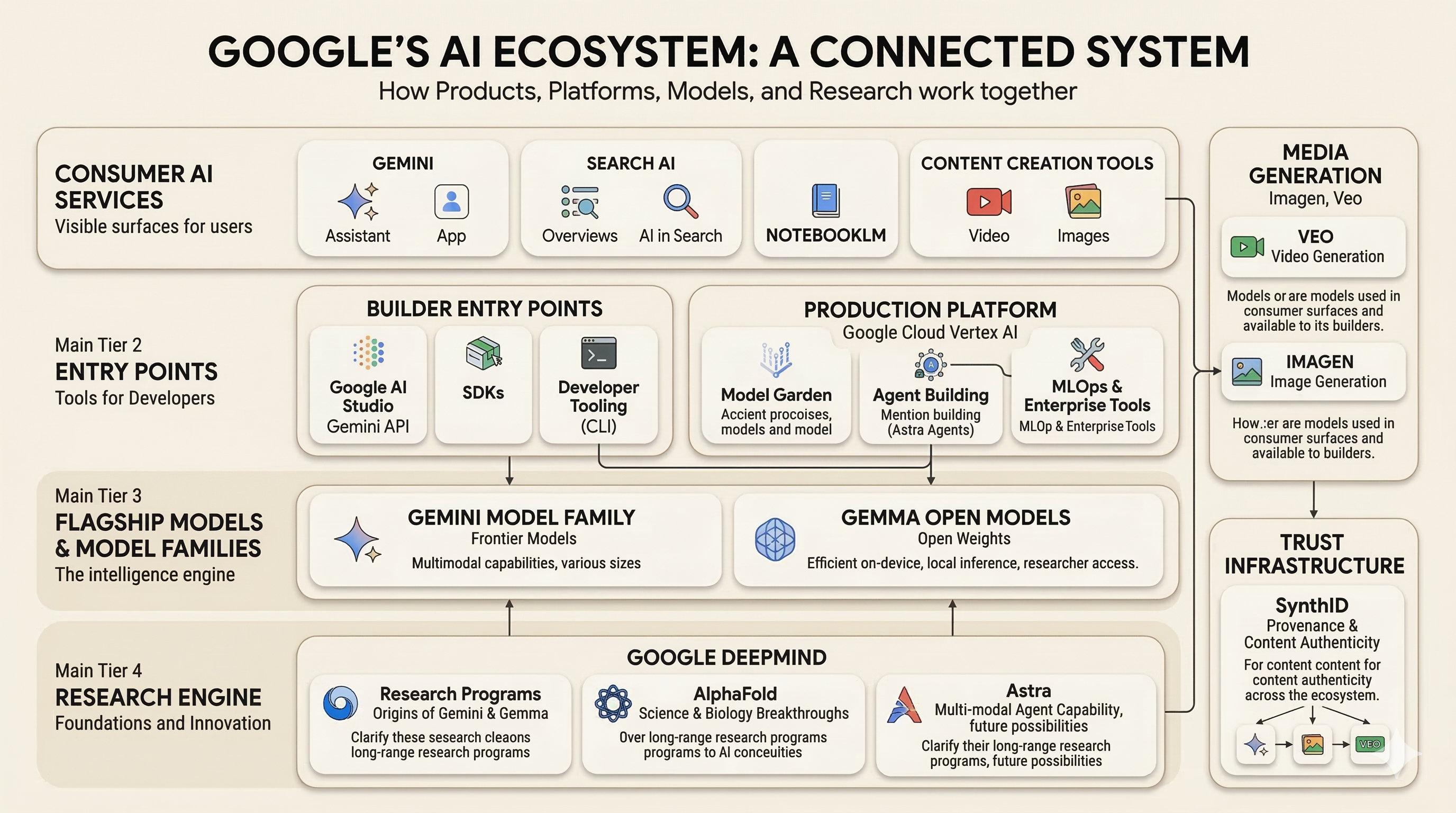
Google’s AI stack is easiest to understand as two overlapping fronts: consumer AI surfaces on one side, and developer or enterprise AI infrastructure on the other. The same Gemini model family and Google research pipeline feed both.
- Consumer layer: Gemini app, Search AI experiences, NotebookLM, media tools
- Builder layer: Gemini API, AI Studio, Vertex AI, agent tooling
- Research layer: DeepMind, Gemma, media models, safety systems
Consumer products are now a real AI surface area
The Gemini app has become Google’s general assistant surface, while NotebookLM handles source-grounded synthesis and Search adds AI answers and AI Mode-style workflows. Flow, Veo, and Imagen extend that surface into AI media creation.
- Gemini app: assistant, Gems, deep research, multimodal workflows
- NotebookLM: source-grounded reasoning and audio overviews
- Search AI features: AI Overviews and AI Mode direction
- Flow + Veo + Imagen push consumer and creator AI together
The developer on-ramp starts with AI Studio and the Gemini API
For builders who want direct model access without immediately adopting the full Google Cloud platform, AI Studio and the Gemini API are the cleanest starting point. This is the prototyping and SDK layer of the ecosystem.
- AI Studio is the quick-start surface
- Gemini API and SDKs are the main programmable entry point
- Gemini CLI extends the stack into local developer workflows
- Firebase and app tooling increasingly connect to Gemini features
Vertex AI is the platform center of gravity
Once the story becomes production deployment, enterprise workflows, agent systems, model management, or governed evaluation, the center moves to Vertex AI. That is where Google’s AI ecosystem becomes a real platform rather than just a family of APIs.
- Vertex AI is the main cloud control plane for production AI
- Model Garden is the multi-model catalog layer
- Agent tooling pushes the platform toward full AI systems
- Gemini Code Assist sits near this enterprise layer
Google is pursuing both closed frontier models and open models
The ecosystem is not only about Gemini. Google is also using Gemma as its open-model family, which gives it a second lane for smaller-footprint deployment, community experimentation, and open ecosystem reach.
- Gemini is the flagship frontier model family
- Gemma is the open-model family
- This lets Google play both platform and open-distribution games
DeepMind is still the research engine behind the roadmap
Google DeepMind remains the source of much of the ecosystem’s long-range ambition. Project Astra, AlphaFold, robotics work, SynthID, and media model research show that Google sees AI as a broad platform spanning assistants, science, media, and trust infrastructure.
- Project Astra points toward more ambient assistant behavior
- AlphaFold anchors the science side of the AI strategy
- SynthID is part of the provenance and watermarking story
- Media model work feeds both research and product surfaces
Current takeaway
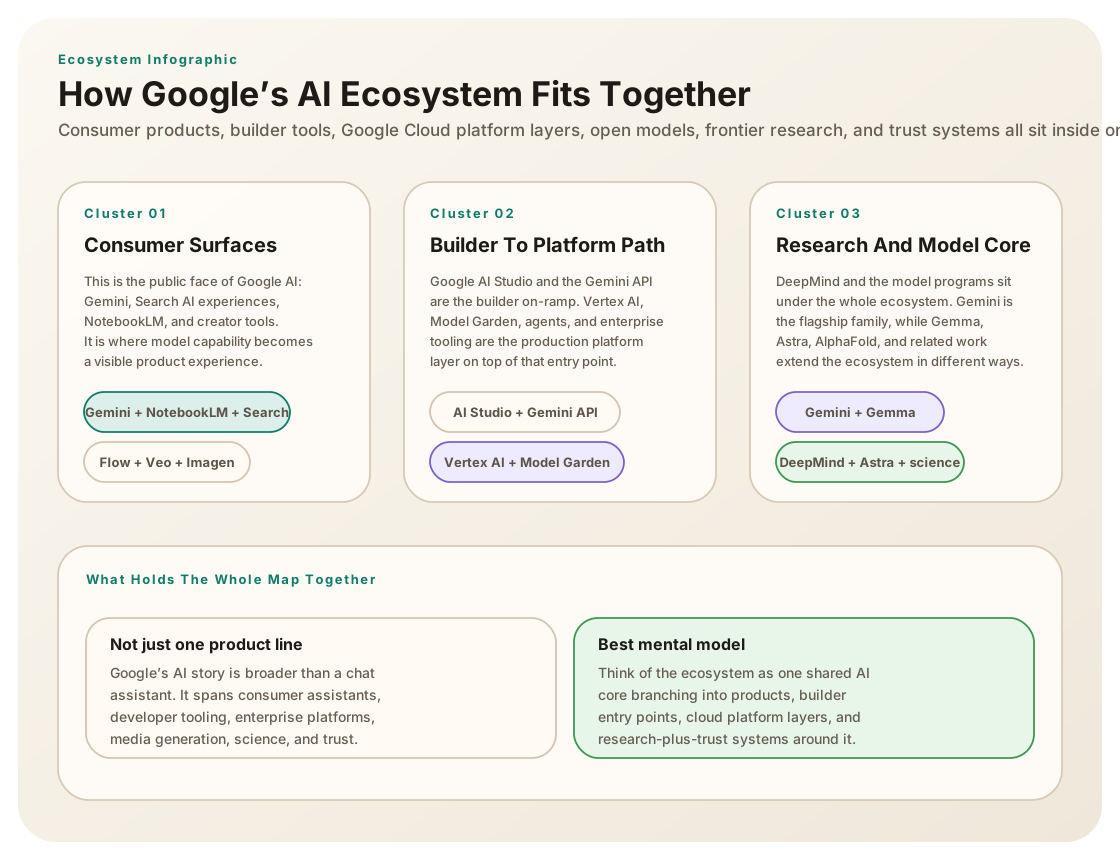
The clearest mental model is: Gemini is the flagship model family, Gemini app and Search are consumer surfaces, AI Studio and the Gemini API are the builder on-ramp, Vertex AI is the production platform, and DeepMind plus Gemma plus SynthID define the broader research and trust perimeter.
- Consumer AI: Gemini, NotebookLM, Search, media tools
- Builder AI: AI Studio, Gemini API, SDKs, CLI
- Platform AI: Vertex AI, Model Garden, agents, Code Assist
- Research and trust: DeepMind, Gemma, SynthID, AlphaFold, Astra